Monday, May 7, 2012

Butterfly Metamorphosis

 Butterfly Metamorphosis!


Here is a wonderful video of a little girl named Greyson. She went to a butterfly enclosure and here is what she has to say about Metamorphosis! Check her out. She is awesome!

Sunday, November 20, 2011

Butterfly Tile Art

Beautiful Butterfly Art Tiles at Affordable Prices!

Last year I painted 12 butterflies/moth paintings in graphite and gouache. I started with a dead specimen and observed it under the microscope. In graphite I drew the background to show the wing/scale structure of each one and then painted the butterfly/moth on top of the enlargement. The response to them have been super so I decided to create them in ceramic tile form. They are available in 4 x 4 coasters, 6 x 6 & 8 x 8 tiles. The larger size has a high quality easel backing that allows the tile to be displayed on a shelf and a clip so that it can hang on the wall.
These are the designs that are currently available in my Etsy Store. Please visit my shop and tell you friends and family about my work to help me grow my art business.

Friday, September 2, 2011

Monarch Butterfly Festival


I am happy to announce that I will be participating in the 1st Annual Florida Monarch Festival in Earleton, Florida on Saturday September 24, 2011. I discovered the GreatHouse Butterfly Farm just a few months ago when I was doing a search on google for butterfly farms. It turns out that I am within 30 minutes of 2 wonderful butterfly farmers; Greathouse Butterfly Farm and Shady Oak Butterfly Farm. Many people have asked me why Gainesville, Florida?  National Geographic named it #7 in the USA to retire to for nature in 2007. It has an abundance of things to see and do that are all nature related. This festival couldn't have come at a better time! I will be promoting and signing my book Mother Monarch at the festival, showing my paintings and selling my new greeting cards and tile art. If you live in the area it would be wonderful to see you at the festival.  For those who are not local I will be sure to post pics and a review of the festival. Keep your fingers crossed that we don't have rain. It is a rain or shine event. 

For more information about the festival click here.

"Like" Mother Monarch on Facebook
Follow me on Twitter! 


Wednesday, August 31, 2011

Fantastic Video by Ba Rae

I love the internet! I have been using Facebook and Twitter and have found so many fabulous groups that are butterfly fans! Here is a list of those groups that I think you will enjoy:

http://www.facebook.com/theloveofbutterflies
http://www.facebook.com/ShadyOakButterflyFarm
http://www.facebook.com/ButterflyPavilion
http://www.facebook.com/butterflynature
http://www.facebook.com/pages/Greathouse-Butterfly-Farm/119110954790042
http://www.facebook.com/groups/303259184298/

Here is a fantastic video that shows the lifecycle of the Monarch butterfly. It describes the entire process from egg to adult.


This was made by Ba Rae and you can find more about her on her facebook page at:

http://www.facebook.com/pages/Bas-Relief-LLC/190049684378053

"Like" Mother Monarch on Facebook
Follow me on Twitter!


Monday, August 1, 2011

Monarch Butterflies can swim!

I recently had the wonderful opportunity to visit Shady Oak Butterfly Farm in Brooker, Florida. Edith Ellen Lee Smith is the owner of the farm along with her husband, children and grandchildren. They raise and supply butterflies for weddings, funerals, but mostly for live educational exhibits. They ship butterfly chrysalises all over the country. I went on a tour of the farm. They had a green house full of host plants to feed the caterpillars. There were sterilized boxes with munching caterpillars and more boxes of chrysalises. They had breeding cages for adult butterflies to mate along with host plants for the female to lay eggs on. They are very careful  keeping the place sanitary and use bleach to clean the eggs. I was shocked when she told me that! I thought that bleach would kill the egg for sure! We went into "the bleaching room" and watched Edith bleach the tiny caterpillar eggs. She used a diluted solution of bleach and water and rinsed the eggs for about 15 seconds and then she rinsed them with just water. Just this small amount of time reduces the risk of the disease. The newly hatched caterpillar often eats the shell of its egg upon emerging so the bleaching ensures a tasty, free of germs meal! Another surprise I encountered was that butterflies can survive being submerged into water and will actually use their wings to propel themselves to the surface. It almost looks like they are swimming. Maybe this is how the swim stroke was called "The Butterfly". Edith demonstrates this in the following video.


I have had many comments on Facebook and Twitter asking why anyone would submerge a butterfly in water. Some of you have said that it is cruel. It was not intended to and did not hurt the butterfly in any way. It was intended to show people just how strong butterflies are. In many ways they seem so fragile to us. A Monarch must travel great distances and be subjected to harsh weather, storms, wind, rain. They often have to fly over lakes, and streams. It was to demonstrate how awesome they are! Please know that the butterfly was not hurt during the making of this video. To learn more about butterflies and what Edith does visit her at Butterfly Fun Facts. She adds something amazing almost everyday!


Enjoy!


Mindy


Facebook:  http://www.facebook.com/MotherMonarch
Twitter: http://www.twitter.com/Mlighthipe

Wednesday, April 6, 2011

Nature's Wisdom Oracle Cards

I have the wonderful opportunity to announce that my Nature's wisdom Oracle cards from Schiffer Publisher is finally arrived. About a year ago my book, Mother Monarch was released and they offered me the opportunity to write and illustrate a deck of oracle cards. I had never embarked on a project of this kind so I needed to do some research.

According to Wikipedia "Oracle card decks claim to provide insight and positive outlooks to people. They are conceptually similar to divinatory tarot cards, but they are often not divided into playing card tarot cards. Unlike the Tarot, oracle cards are not known to be used for card games. Oracle decks often differ in the number of cards. Common themes used in oracle card decks involve the power of positive thought and metaphysical beings such as angels, fairies, mermaids and unicorns. These cards are sometimes called "fortune telling packs". They often lack what is often seen as the "darker" images of traditional Tarot Cards.

I have always related to nature and find that there is so much to be learned from Mother Nature. As I began to think more and more about my deck of cards I started to make a list of bugs, beasts and botanicals that had special meaning to me. I read lots of books and researched my way through the internet to come up with the imagery, symbolism and folklore that I felt would help others gain insights into their daily challenges, future aspirations and past decisions. I came up with 48 cards that I believe will help to guide people along the path as nature intended us to walk. I will periodically post each image and you can read the information I have in the book.  My first card is  

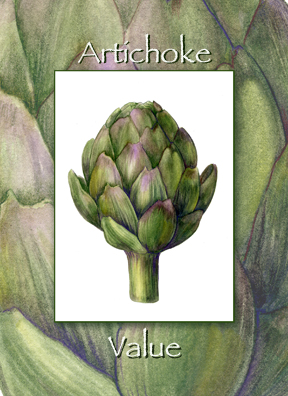
The Artichoke

The artichoke symbolizes value. It is a perennial plant belonging to the thistle family.  The flower or the head of the plant is commonly referred to as the heart. 

In Greek mythology Zeus fell in love with a beautiful woman named Cynara. She missed her family so much that she would sneak back to earth. When Zeus discovered this, he banished her to earth and turned her into an artichoke. 

In today’s cuisine, the artichoke is considered a delicacy.  The exterior is tough and only a tiny portion of the plant is edible. It takes a lot of preparation and cooking in order to make it tender. Each leaf is peeled off and must be scraped off the flesh of the plant.


Special message:
The artichoke challenges you to find the value of your present situation.  Look deep inside your heart and see if there is something special hidden within the harshness of the exterior. The work involved in the discovery may uncover something of great value to you.


If you are interested in your own deck of Nature's Wisdom Oracle cards you can purchase them from me here on this website:
 $24.99 + $4.95 shipping and handling fee


I hope that you enjoy them!
Cheers,
Mindy


Friday, December 3, 2010

Bradley Beach Elementary School- 6th Grade Art Class

Today I had the wonderful experience of going to the Bradley Beach Elementary School in Bradley Beach, NJ to teach 25 young artists how to draw a butterfly. I took my book, Mother Monarch with me. I read the book out loud to them and during the reading I had the original paintings and was able to hold them up for the children to see. I showed them how I drew the paintings and talked about all the research it took from raising the caterpillars and growing the milkweed. They learned what was involved in putting a book together and how I worked with my story to create each picture for the book. After the story was over I was able to use a digital visual projector named "Elmo" to draw a butterfly with the group. "Elmo" allowed me to draw a butterfly on a piece of paper while my hand was  under a camera. The camera enlarged the drawing and it projected it onto the wall so the students could draw with me step by step. It was loads of fun and everyone created a one of kind butterfly. Each one was unique!


Do you have a group of young artists that you would like a school presentation for? You can contact Mindy at Mlighthipe@mac.com for information on how you can have her visit your school too.


Thursday, November 18, 2010

Wednesday, November 17, 2010

Museum boosts sales of Mother Monarch during Butterfly Fest

I had the wonderful experience of participating in Butterfly Fest at the Museum of Natural History in Gainesville, Florida in October. It was a blast. There were over 6,000 visitors. They were all ages and sizes and many were wearing their butterfly wings. My solo show opened at the museum in conjunction with Butterfly Fest. I was able to do a book signing of my new book, Mother Monarch. Here are a few pics of my new friend Gwen Thompson and her band of merry butterflies passing my exhibit spreading joy and pollen through the museum!


Monday, September 13, 2010

American Lady Butterfly (Vanessa virginiensis)
Insect Art to promote insect growth and development


The American Lady is a member of the Brushfoot family (Nymphalidae) and the True Brushfoot (Nymphalinae) subfamily. Its range includes most of the USA and parts of northern Mexico and southern Canada, migrating north from its winter home in Florida or Mexico. In summer it can be seen as far north as Canada. American Ladies fly south again in the fall. Exhibiting a rapid, nervous flight pattern, it prefers open areas such as fields, meadows, and roadsides and is attracted to low-growing nectar and host plants, here depicted on Zinnia elegans. The caterpillars feed on Pearly Everlasting (Anaphalis margaritacea), Cudweeds (Gnaphalium), and Pussytoes (Antennaria plantaginifolia), pictured. The caterpillar binds several leaves together to form a silky nest and hiding place (as pictured here). The American Lady’s most striking distinguishing features are the two large blue-centered eyespots on its hind wings.

Artist: Mary Christiansen
E-mail: mary.christiansen@yahoo.com

Tuesday, August 31, 2010

Cabbage White (Pieris rapae)
 Insect Art to promote insect development.


The Cabbage White is found in every part of North America, from Northern Canada to Mexico, and in many other parts of the world. Originally an African and Eurasian species, it was introduced into Quebec Province in 1860. In a matter of decades, the butterfly had spread across the continent. The larvae of Cabbage Whites feed only on plants containing mustard oil, principally members of the Brassicaceae family. This characteristic makes them very unpopularwith farmers, since many brassicas are food plants for humans, as well. The mustard oil renders them unpalatable to birds, certainly a reason that these butterflies are so prolific. The adults nectar on a wide variety of flowers, including those of Asteraceae, Lamiaceae and Brassicaceae.The adults illustrated here are nectaring on Blazing Star (Liatris spicata).The larvae and a pupa are shown as observed on Tuscan Kale (Brassica oleracea).

Artist: Lanis Monfried
E-mail address: laniswm@optonline.net

Tuesday, August 17, 2010

Common Buckeye Butterfly

Common Buckeye (Junonia coeni)
Insect art to promote insect growth and development.


Named for it distinctive eye spots on its wings, the Common Buckeye has a wingspan of 2 - 2.5 inches.  The Buckeye prefers open, sunny areas with some bare ground and low vegetation. It is shown here
with Common Lantana (Lantana camara). During the day males perch to watch for females, flying periodically to chase other flying insects. Females lay eggs singly on the topside of host plant leaves upon which the caterpillar feeds (Depicted here is the Common Broad-leaved Plaintain (Plantago major).The Buckeye is found throughout the southern United States and north along the coasts. Although the Buckeye flies in summer throughout much of North, it is not able to overwinter very far north. In the autumn along the East Coast, there are impressive southward migrations. In places such as Cape May, New Jersey, the October hordes of Buckeyes drifting southward rival those of Monarchs in number and spectacle.

Artist:  Douglas Nieters  
E-mail address:  doug.nieters@credit-suisse.com
Website: http://www.dougnieters.com

Thursday, July 22, 2010

Tulip Tree Moth

Tulip-tree Silkmoth (Callosamia angulifera)
 
Insect art to promote insect growth and development.

The Tulip-tree Silkmoth, a member of the Giant Silkworm family (Saturniidae), is found in the woodlands and forests of eastern North America. Silkworm moths exist solely to mate. Having no mouths, they neither eat nor drink and live for only a week. They are nocturnal, with distant males responding to the female’s pheromones, and mate between dusk and midnight. At dusk the following  evening the female lays eggs, in rows of 4-10, on the leaves of the tulip tree. The eggs hatch in a week with young caterpillars feeding in groups. Older caterpillars do not eat the main vein of the leaf and are solitary creatures. In nature the caterpillar feeds only on the tulip tree, also called the yellow poplar, (Liriodendron tulipifera); its range matches that of the tree, shown here. The cocoon, in a curled tulip tree leaf, is not attached beyond the petiole and falls to the ground where it overwinters.

Artist: Elise Ross
E-mail address:  elisejr@optonline.net

Thursday, July 8, 2010

American Copper (Lycaena phlaeas)

American Copper (Lycaena phlaeas)  
Insect art to promote insect growth and development.


American Copper is a common widespread little butterfly that ranges from Nova Scotia south to Georgia, Tennessee, and Arkansas; west across the Great Lakes to North Dakota. In the east it can be found in open or disturbed areas, including pastures, fields, and landfills. This small butterfly has a wing span of 7/8 to 1 3/8 inches. Males perch on grass or weeds to wait for receptive females. Females lay ribbed, pale green eggs singly on the stems or leaves of its host plant, sheep sorrel, (Rumex acetosella). The chrysalis overwinters in leaf litter. There are between two and three broods a year.  The caterpillar can be reddish to yellowish-green, possibly marked with red on the back or sides. It reaches an average length of 3/4 inch. Caterpillars feed on Rumex acetosella by chewing holes on the underside of the leaves. Adult butterflies drink nectar from many flowers including buttercup, white clover, and butterfly weed.

Artist: Beth Rhame

Contact Beth at: Banditboo2@aol.com

Monday, June 28, 2010

Cecropia Moth - Insect Art

Cecropia Moth (Hyalophora cecropia)


The adult Cecropia, a member of the Giant Silkworm family, do not have functioning mouthparts and do not feed. This characteristic has coevolved along with their pheromone mating system: the ability of females to attract distant males, and thus their characteristic feathery antennae. They range east of the Rocky Mountains and are found in a variety of open areas such as backyards and woodlands. The caterpillar eats the foliage of many trees and shrubs. This specimen was hand-reared on Black Cherry, Prunus serotina. It uses nearby foliage as a mold to start spinning its cocoon, producing a complex "cocoon within a cocoon" double structure. The inner cocoon is suspended within a network of loose silk resembling coarse steel wool.The caterpillar is capable of varying its silk color to match dried foliage or branches from which it is suspended. The cocoon over-winters and the moth emerges in May.

Artist: Kathie Miranda
E-mail address: kathiemiranda@me.com
Website: http://www.kathiemiranda.com

Sunday, June 13, 2010

Saturday, June 12, 2010

Atala Butterfly (Eumaeus atala)

Atala Butterfly (Eumaeus atala)
Insect art to promote insect growth and development.

The Atala Butterfly, once thought to be extinct, is native to Florida. The host plant is the Florida coontie (Zamia floridana), which is a cycad, a "living fossil," (a form of the primitive plant life from the dinosaur era). The Atala can tolerate the natural toxins in coonties and uses the accumulated toxins and its brilliant coloration as a defense against bird predators. The female lays her eggs, five to fifteen, usually, on coontie stalks (depicted here) or deposited on the apex of mature leaflets. Caterpillars are known to be cannibalistic. The butterfly emerges in the early morning, courts and mates in the late afternoon, and dies within ten days.The nectar plant depicted here is the White Indigo Berry (Randia aculeata), a member of the Rubiaceae family. It is a pineland shrub with white, salmon-blushed fruit, and white star-shaped flowers that are exuberantly fragrant.

Artist: Sarah Saltus Siddig
E-Mail Address: sarahsaltsid@comcast.net

Friday, May 21, 2010

Eastern Tiger Swallowtail

Insect art to promote insect growth and development.


Eastern Tiger Swallowtail (Papilio glaucus)
Two females are shown laying eggs on the leaves of Wild Black Cherry (Rosaceae prunus serotina), a preferred host plants. The branches are depicted as they appear in late spring (full blossom) and in late summer with ripe fruit.The Eastern tiger swallowtail reaches a wingspan of 4.8 to 5 inches. The female appears in two forms, a yellow form and a dark form, the latter being protective as it imitates the Pipevine Swallowtail which has a bitter taste.The eggs are laid on the top of the leaf and are among the very largest butterfly eggs (shown near each female.) The first instar of caterpillar resembles bird droppings. The final instar is a lovely green with lighter sides and large markings resembling eyes. It can measure up to 5.5 centimeters. The chrysalis usually hangs upright on a twig from a thread near the juncture of the thorax and abdomen.

Artist: Marsha Ra
marsha@marshara.com
Website: http://www.marshara.com

Tuesday, May 11, 2010

Mother Monarch makes a great gift for teachers

Teachers will love it!


 Purchase the book $19.95 + $4.95 USPS     

The school year is coming to close. Just a few more weeks and the days will be warm and it will be Schools Out for the summer. Yippee! Do you have a special teacher that you would like to give a gift to? This wonderful book is a fantastic way to say, " Thanks Teacher! I appreciate you!" 

Here is what people are saying about Mother Monarch:

"Your new book is WONDERFUL!  Every illustration is beautiful!  I am thrilled to have it in my possession!" Little Silver, New Jersey

"Our mouths were wide with wonder at the remarkable tale of these beautiful creatures. I learned so much and was left in awe of them."  Raleigh, North Carolina

Monday, May 3, 2010

Hummingbird Clearwing Moth

Hummingbird Clearwing Moth (Hemeris thysbe)
Insect art to promote insect growth and development.

The Hummingbird Clearwing moth is a small dayflying moth. Often mistaken for a hummingbird, the
moth can be seen hovering over flowers, never landing on them, using its long proboscis to extract
nectar. Butterfly bushes, red bee balm and Casa Blanca lilies are their favorites in my garden. Eggs are
laid singly on the host plants of the Honeysuckle family, and it is not unusual to find several caterpillars
feeding on the same plant. The anal horn on the back of the caterpillar is red and very long when the
caterpillar is young, but turns blue just prior to pupation, depicted. Clearwings pupate in a weak
cocoon spun among fallen leaves. The “clear” wing appears as scales wear off soon after the moth
emerges. Scale of drawing is as follows: Clearwing moth is shown in actual size and five times
magnification. Caterpillars and pupas are shown in two times magnification.

Artist: April Flaherty
E-mail: April_Flaherty@yahoo.com
Website: http://www.aprillouisedesign.com