Wednesday, April 6, 2011

Nature's Wisdom Oracle Cards

I have the wonderful opportunity to announce that my Nature's wisdom Oracle cards from Schiffer Publisher is finally arrived. About a year ago my book, Mother Monarch was released and they offered me the opportunity to write and illustrate a deck of oracle cards. I had never embarked on a project of this kind so I needed to do some research.

According to Wikipedia "Oracle card decks claim to provide insight and positive outlooks to people. They are conceptually similar to divinatory tarot cards, but they are often not divided into playing card tarot cards. Unlike the Tarot, oracle cards are not known to be used for card games. Oracle decks often differ in the number of cards. Common themes used in oracle card decks involve the power of positive thought and metaphysical beings such as angels, fairies, mermaids and unicorns. These cards are sometimes called "fortune telling packs". They often lack what is often seen as the "darker" images of traditional Tarot Cards.

I have always related to nature and find that there is so much to be learned from Mother Nature. As I began to think more and more about my deck of cards I started to make a list of bugs, beasts and botanicals that had special meaning to me. I read lots of books and researched my way through the internet to come up with the imagery, symbolism and folklore that I felt would help others gain insights into their daily challenges, future aspirations and past decisions. I came up with 48 cards that I believe will help to guide people along the path as nature intended us to walk. I will periodically post each image and you can read the information I have in the book.  My first card is  

The Artichoke
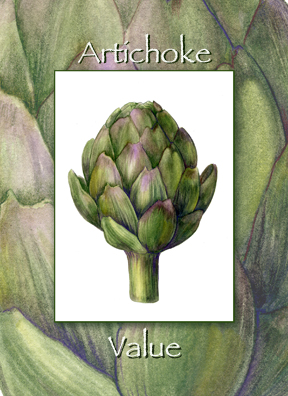
The artichoke symbolizes value. It is a perennial plant belonging to the thistle family.  The flower or the head of the plant is commonly referred to as the heart. 

In Greek mythology Zeus fell in love with a beautiful woman named Cynara. She missed her family so much that she would sneak back to earth. When Zeus discovered this, he banished her to earth and turned her into an artichoke. 

In today’s cuisine, the artichoke is considered a delicacy.  The exterior is tough and only a tiny portion of the plant is edible. It takes a lot of preparation and cooking in order to make it tender. Each leaf is peeled off and must be scraped off the flesh of the plant.


Special message:
The artichoke challenges you to find the value of your present situation.  Look deep inside your heart and see if there is something special hidden within the harshness of the exterior. The work involved in the discovery may uncover something of great value to you.


If you are interested in your own deck of Nature's Wisdom Oracle cards you can purchase them from me here on this website:
 $24.99 + $4.95 shipping and handling fee


I hope that you enjoy them!
Cheers,
Mindy


Friday, December 3, 2010

Bradley Beach Elementary School- 6th Grade Art Class

Today I had the wonderful experience of going to the Bradley Beach Elementary School in Bradley Beach, NJ to teach 25 young artists how to draw a butterfly. I took my book, Mother Monarch with me. I read the book out loud to them and during the reading I had the original paintings and was able to hold them up for the children to see. I showed them how I drew the paintings and talked about all the research it took from raising the caterpillars and growing the milkweed. They learned what was involved in putting a book together and how I worked with my story to create each picture for the book. After the story was over I was able to use a digital visual projector named "Elmo" to draw a butterfly with the group. "Elmo" allowed me to draw a butterfly on a piece of paper while my hand was  under a camera. The camera enlarged the drawing and it projected it onto the wall so the students could draw with me step by step. It was loads of fun and everyone created a one of kind butterfly. Each one was unique!


Do you have a group of young artists that you would like a school presentation for? You can contact Mindy at Mlighthipe@mac.com for information on how you can have her visit your school too.


Thursday, November 18, 2010

Wednesday, November 17, 2010

Museum boosts sales of Mother Monarch during Butterfly Fest

I had the wonderful experience of participating in Butterfly Fest at the Museum of Natural History in Gainesville, Florida in October. It was a blast. There were over 6,000 visitors. They were all ages and sizes and many were wearing their butterfly wings. My solo show opened at the museum in conjunction with Butterfly Fest. I was able to do a book signing of my new book, Mother Monarch. Here are a few pics of my new friend Gwen Thompson and her band of merry butterflies passing my exhibit spreading joy and pollen through the museum!


Monday, September 13, 2010

American Lady Butterfly (Vanessa virginiensis)
Insect Art to promote insect growth and development


The American Lady is a member of the Brushfoot family (Nymphalidae) and the True Brushfoot (Nymphalinae) subfamily. Its range includes most of the USA and parts of northern Mexico and southern Canada, migrating north from its winter home in Florida or Mexico. In summer it can be seen as far north as Canada. American Ladies fly south again in the fall. Exhibiting a rapid, nervous flight pattern, it prefers open areas such as fields, meadows, and roadsides and is attracted to low-growing nectar and host plants, here depicted on Zinnia elegans. The caterpillars feed on Pearly Everlasting (Anaphalis margaritacea), Cudweeds (Gnaphalium), and Pussytoes (Antennaria plantaginifolia), pictured. The caterpillar binds several leaves together to form a silky nest and hiding place (as pictured here). The American Lady’s most striking distinguishing features are the two large blue-centered eyespots on its hind wings.

Artist: Mary Christiansen
E-mail: mary.christiansen@yahoo.com

Tuesday, August 31, 2010

Cabbage White (Pieris rapae)
 Insect Art to promote insect development.


The Cabbage White is found in every part of North America, from Northern Canada to Mexico, and in many other parts of the world. Originally an African and Eurasian species, it was introduced into Quebec Province in 1860. In a matter of decades, the butterfly had spread across the continent. The larvae of Cabbage Whites feed only on plants containing mustard oil, principally members of the Brassicaceae family. This characteristic makes them very unpopularwith farmers, since many brassicas are food plants for humans, as well. The mustard oil renders them unpalatable to birds, certainly a reason that these butterflies are so prolific. The adults nectar on a wide variety of flowers, including those of Asteraceae, Lamiaceae and Brassicaceae.The adults illustrated here are nectaring on Blazing Star (Liatris spicata).The larvae and a pupa are shown as observed on Tuscan Kale (Brassica oleracea).

Artist: Lanis Monfried
E-mail address: laniswm@optonline.net

Tuesday, August 17, 2010

Common Buckeye Butterfly

Common Buckeye (Junonia coeni)
Insect art to promote insect growth and development.


Named for it distinctive eye spots on its wings, the Common Buckeye has a wingspan of 2 - 2.5 inches.  The Buckeye prefers open, sunny areas with some bare ground and low vegetation. It is shown here
with Common Lantana (Lantana camara). During the day males perch to watch for females, flying periodically to chase other flying insects. Females lay eggs singly on the topside of host plant leaves upon which the caterpillar feeds (Depicted here is the Common Broad-leaved Plaintain (Plantago major).The Buckeye is found throughout the southern United States and north along the coasts. Although the Buckeye flies in summer throughout much of North, it is not able to overwinter very far north. In the autumn along the East Coast, there are impressive southward migrations. In places such as Cape May, New Jersey, the October hordes of Buckeyes drifting southward rival those of Monarchs in number and spectacle.

Artist:  Douglas Nieters  
E-mail address:  doug.nieters@credit-suisse.com
Website: http://www.dougnieters.com